
Ever since Broadcom acquired VMware, nothing is the same. vSphere licensing was switched to a core-based subscription model in 2024, VMware Cloud Foundation is pushed as a bundle, and prices have risen 30–300% — depending on who you ask. For many data center operators, this is the moment they seriously evaluate alternatives for the first time in 15 years.
This article compares the three relevant enterprise platforms: VMware vSphere (the incumbent), Citrix XenServer (the commercial hypervisor with open-source roots), and Nutanix (the HCI platform that unifies storage and compute). This is not a homelab comparison — it's about licensing models, storage architectures, support, and migration paths.
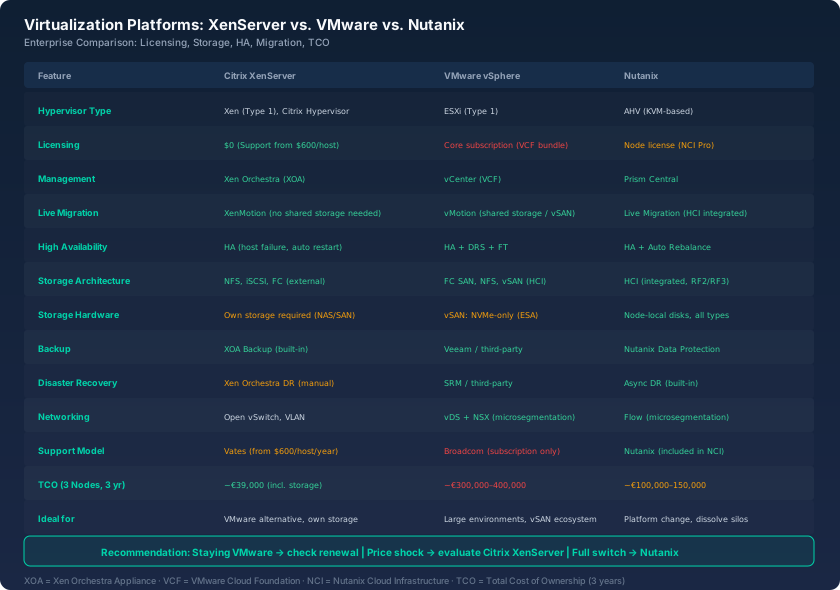
VMware vSphere: The Incumbent Under Pressure
VMware has been the standard for 20 years. vSphere 8 runs in an estimated 70% of virtualized data centers worldwide. The technology is mature: vMotion (live migration with zero downtime), DRS (automatic load balancing across clusters), HA (automatic restart on host failure), FT (fault tolerance for critical VMs) — this has been working reliably for years.
But the Broadcom acquisition turned the licensing model upside down. Where you used to license per CPU socket, you now pay per physical core — with a minimum of 16 cores per CPU. A server with two 32-core EPYCs: 64 cores × list price. VMware Cloud Foundation (VCF), which bundles vSphere, vSAN, and NSX, is being forced by Broadcom as the only offering for new customers. vSphere Standard and Enterprise Plus can only be renewed by existing customers.
For a 3-node cluster with 2×32 cores each and 3 years of VCF licensing, list prices run around €300,000–400,000. That is not a typo. The alternative: renew vSphere Standard for existing customers as long as you can — or migrate.
Citrix XenServer: The Underestimated Enterprise Contender
XenServer is the hypervisor that AWS EC2 runs on. The architecture is a Type 1 hypervisor (Xen) that has been in production use for over 15 years. Citrix XenServer is the commercial product — for an open-source variant, look at XCP-ng, the fork of XenServer 7.x maintained since 2018 by the French company Vates. Commercial support is available for both: directly from Citrix for XenServer, from Vates for XCP-ng starting at €600/host/year.
What makes this interesting for data centers: Citrix XenServer supports live migration (XenMotion) across cluster boundaries, even without shared storage. Storage XenMotion migrates VMs including their disks. HA with automatic restart on host failure is part of the feature set. The management interface Xen Orchestra (XOA) runs as an appliance and provides role-based access, backup, monitoring, and a REST API.
What Citrix XenServer doesn't have: DRS-like automatic load balancing. No VM-level fault tolerance. No native storage replication like vSAN. In return, the hypervisor costs €0, support runs €600–1,200/host/year, and XOA is available from €100/month for unlimited hosts. A 3-node cluster with 3 years of XOA support: under €15,000 — two orders of magnitude below VMware.
For environments that don't need continuous automatic VM rebalancing, Citrix XenServer is a serious alternative. We're currently evaluating it for two clients with 20–50 hosts each, specifically because of VMware price increases.
Nutanix: HCI That Thinks Differently About Everything
Nutanix isn't a hypervisor — it's a complete hyperconverged infrastructure (HCI) platform. Every node contributes local storage, which the Nutanix Acropolis Distributed Storage Fabric pools into a cluster-wide storage volume. The hypervisor (AHV, KVM-based) is integrated. VMware ESXi is optionally supported.
For data centers, Nutanix is compelling because it dissolves storage and compute silos. No separate SAN, no FC switches, no LUNs. You rack three or more nodes, configure the cluster once, and from then on Prism (the management interface) manages everything — including one-click upgrades of the entire stack.
Enterprise features: live migration, HA, container-based microsegmentation (Flow), disaster recovery with async replication, file and object storage on the same cluster. Nutanix Files replaces Windows File Server, Nutanix Objects replaces S3-compatible storage appliances.
Costs: Nutanix doesn't publish list prices. Benchmarks from RFPs: a 3-node cluster with 3 years of Pro licensing and support runs €80,000–150,000. More expensive than Citrix Citrix XenServer, cheaper than VMware VCF — and you save on external storage. Nutanix makes sense from 4 nodes up; below that, it's oversized.
Subnet Calculator for Network Segmentation
With 50 VMs per host and three hosts in a cluster, you quickly need 150 IP addresses in the management network, plus vMotion/XenMotion/backup VLANs. The bitcalc Subnet Calculator shows whether your /24 management network is enough: 150 VMs + 3 host IPs + 3 management interfaces + 3 storage interfaces = 159 addresses — 95% utilization. A /23 gives you room, a /22 room to grow.
With Nutanix, storage interfaces are gone (because HCI), but each node adds a CVM (Controller VM). With VMware and vSAN, same story: vSAN kernel ports need their own IPs. IP address management is often underestimated in virtualization — especially when scaling from 10 to 30 hosts.
Storage Architectures Compared
This is where the platforms fundamentally diverge:
VMware vSphere with FC SAN: The classic setup. Two FC switches, a NetApp/Pure/Dell storage array, LUNs via zoning. Advantage: proven, storage performance is predictable. Disadvantage: expensive. A usable SAN starts at €50,000, FC switches at €15,000 a pair — before licensing.
VMware with vSAN: Hyperconverged, local storage becomes a cluster volume. Advantage: no external storage needed. Disadvantage: vSAN license (included in VCF, separately licensed in Standard), and you need at least 3 nodes with identical disk config. vSAN ESA (Express Storage Architecture) from vSAN 8 requires NVMe-only — SATA SSDs no longer cut it.
Citrix XenServer with NFS/iSCSI: Flexible. You attach any NFS or iSCSI storage, even mixed. No vendor lock-in on storage. Disadvantage: no vSAN equivalent. You need a separate storage system — whether TrueNAS, NetApp, or a Linux NFS server with ZFS.
Nutanix HCI: Storage is integrated into the product. Each node contributes its local disks, and the platform distributes data across the cluster with Replication Factor 2 or 3. Advantage: no separate storage. Disadvantage: you buy storage and compute as a package — if you need more storage, you have to add entire nodes, not just disks.
Migration: The Elephant in the Room
Migrating away from VMware isn't a one-click "Export." VMDK disk images need to be converted to the target format, the network configuration (VMXNET3, port groups, VLAN tagging) must be rebuilt, and the VM tools (VMware Tools → XenServer Tools / Nutanix VirtIO) need to be swapped.
In practice: you export the VM as OVF, import it on the target platform, and hope it boots. In 80% of cases it doesn't, the first time — usually because of storage drivers. Windows VMs need XenServer or VirtIO drivers installed in rescue mode before migration. Linux VMs typically boot, but the network interfaces get renamed (eth0 → enX0), breaking udev rules and network scripts.
For larger environments (50+ VMs), migration tools exist: VMware Converter is the classic, for Citrix XenServer v2v via Xen Orchestra can import VMs directly from vCenter, and Nutanix has the Move tool (formerly Xtract). All three work — but plan 30 minutes of post-migration work per VM. For 100 VMs, that's two weeks of effort.
Cost Comparison (3 nodes, 3 years, 2×32 cores per node)
| VMware VCF | Citrix XenServer | Nutanix Pro | |
|---|---|---|---|
| Hypervisor License | in VCF | €0 | in NCI license |
| Management | vCenter (in VCF) | XOA ~€3,600 | Prism (included) |
| Storage License | vSAN (in VCF) | N/A (external) | included (HCI) |
| Support (3 yr) | in VCF | ~€5,400 | in NCI license |
| External Storage | N/A (vSAN) | ~€30,000 (NAS) | N/A (HCI) |
| Total approx. | €300k–400k | ~€39,000 | €100k–150k |
Figures are benchmarks from real quotes in 2025/2026. VMware VCF costs a multiple because Broadcom targets enterprise customers. Citrix XenServer is almost absurdly inexpensive — but you need your own storage and more hands-on work. Nutanix sits in between and eliminates the storage silo.
Recommendation by Use Case
Keep VMware: If you already run 50+ hosts with vSphere, your storage architecture is built on vSAN or FC SAN, and your renewal increases are under 15%. Migration costs (labor, downtime, risk) often exceed the additional licensing cost in large environments.
Evaluate Citrix XenServer: If you have to leave VMware (price increase over 30%), your storage is external (NFS/iSCSI), and your team has Linux experience. Operations are more CLI-heavy than VMware, but the Xen Orchestra GUI is catching up fast. For standard workloads (web servers, databases, internal tools), Citrix XenServer is production-ready.
Choose Nutanix: If you're doing a complete platform change, your storage is aging, and you want to dissolve silos. Nutanix is pricier than Citrix Citrix XenServer, but cheaper than VMware+storage — and operational overhead drops significantly because you don't manage separate storage anymore.
Bottom line
The VMware world as we knew it is ending. Broadcom is maximizing ARR, which means enterprise customers pay more and smaller customers get pushed out. This isn't a "maybe in five years" problem — the first renewals with 300% markups are hitting accounting departments right now.
Citrix XenServer and Nutanix are the two realistic migration targets. Citrix XenServer for environments with existing storage and Linux-savvy teams. Nutanix for anyone ready to rethink storage and compute together. Both are production-ready, both have commercial support, and both are significantly cheaper than VMware in 2026.
And before you distribute 150 IP addresses across three VLANs: the Subnet Calculator tells you whether your /23 is enough or you need a /22.